Quant Fun
The Gap Between Their Fill and Yours
Four reasons copying a FOMO trader is harder than it looks, where a trader’s gain goes on its way to you, and the execution architecture it takes to close the gap honestly.
You are buying their price impact
Copy trading looks like a solved problem. Watch a wallet, place the same order. It is not solved, and the reasons are not implementation details you can grind away — they are properties of the thing itself. None of them disappears because a tool is well built. What a tool can do is decline the trades where they bite hardest, which is a different and more modest promise than the one usually made.
In the usual case, the trader’s entry is the cheapest print in the sequence: they act on information the rest of the market is about to receive, and the receiving is what moves the price. Everyone who acts on the signal afterwards pays some part of that move. No faster node removes this. It is the structural cost of trading on a public signal, and it is the same adverse-selection problem that decides whether a resting limit order was ever a good idea.
It is worth being precise about who ends up worst off, because the obvious answer is wrong. It is not simply the last person in. The move tends to be front-loaded and then to give part of itself back, so someone who acts much later can pay less than someone who acted near the peak. What is reliable is not an ordering among followers — it is that all of them pay more than the trader did. What you can do about that is narrower and far more useful than “be faster”: measure the move between their fill and your quote, decide in advance what you will not pay, and decline when the number is exceeded. The discipline is not speed. It is the willingness to miss.
Explore this topic
Their size is not your size
A $4,000 buy on a $200,000 book is a 2% position. Copied as a flat $4,000 into a $6,000 account it is about two thirds of everything you own; copied as a flat $20 it is a fraction of a percent and the thesis has been discarded. Flat tickets misstate conviction in both directions and do it silently.
The formula is worth stating precisely, because the denominators are where implementations differ. We compute the source side across the trader’s complete FOMO spot portfolio — both chains — while the follower side is only the allocation on the network being traded. Snapshots refresh on a bounded cadence and a trade uses the one captured before the source transaction, no more than a few minutes old. Missing or stale valuation skips the buy. Nothing is rounded up to a minimum or quietly shrunk to fit the cash that happens to be free.
Exits decide the result, and exits are where products give up
An entry is a single public event, trivially observable. An exit is a different kind of object. The trader may sell in pieces, and the fraction that counts as “the same” exit is genuinely ambiguous for a follower whose cost basis and position size differ. The trader may never sell. The trader may sell into liquidity that has already left by the time your order is built.
A product that mirrors entries well and exits badly has sold you the risk and kept none of the resolution. Our handling is deliberately narrow, and the narrowness is the point: a full exit spends only the position that subscription actually owns. On Solana we additionally support the fraction sold from the trader’s source token account, rounded down against a frozen snapshot of your position — a measurement of that account, not a guess about their whole wallet. On Robinhood Chain, full-position copy exits. Your own exit settings sit above the trader’s, never underneath.
The leaderboard is a biased sample
Rank is computed over survivors. A 30-day memecoin leaderboard is the right tail of a distribution with enormous variance and very heavy tails, and a rank there is the joint outcome of skill and luck. That is not an accusation about anybody’s ability. It is that near the very top of a noisy ranking, the luck term is large relative to the skill term, and the ranking itself cannot tell you how the two divided.
The subtler problem is that a trade count is not an evidence count. A trader with a dozen winning positions opened in the same week, in the same narrative, on correlated tokens, has made something much closer to one bet than to a dozen. Independent observations are what separate skill from variance, and correlated positions do not supply them. This is the reason we are more interested in cohorts than in individuals, which is where the last section of this article ends up.
Explore this topic
Where the gain actually goes
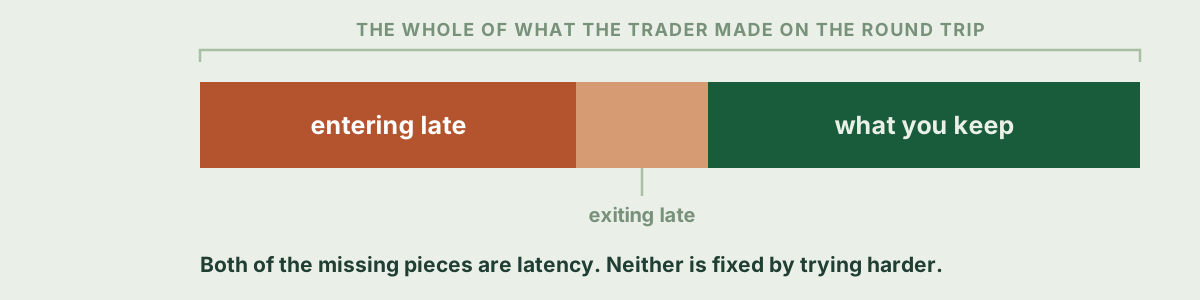
Put those together and a copied round trip has a shape. Whatever the trader made on it, you will not make. What they made arrives at you in three pieces, and the two that are missing from your share are both latency.
The source is not the execution path
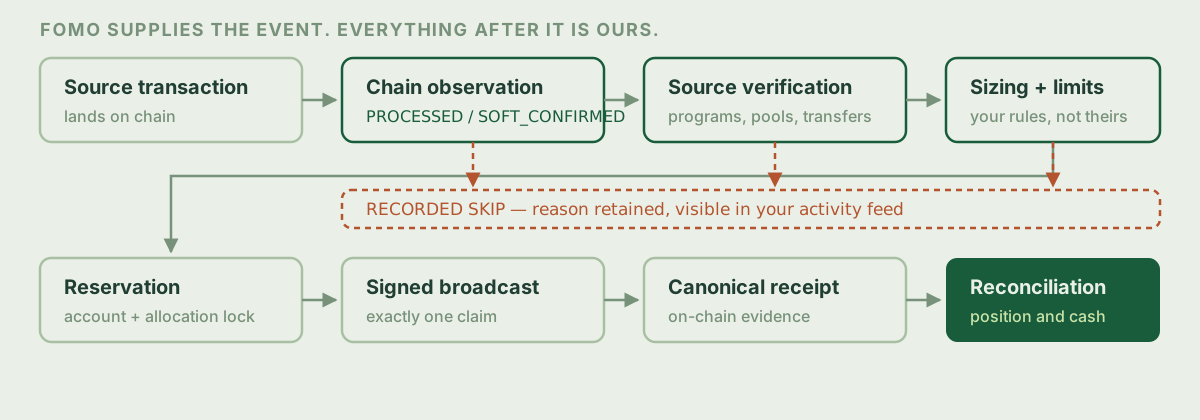
This is the architectural decision everything else follows from, and it is the one that separates a copy product from a relay. FOMO supplies trader discovery and source events. quantfun.trade owns custody, allocation, signing, routing, recovery and position accounting on each chain. We observe the trader’s completed transaction. We never forward it. Their router calldata does not reach your signer, and every copied order is rebuilt from scratch through a venue we have reviewed.
Before any money is committed, the gateway independently verifies the source transaction against the original signed message: program identities pinned to reviewed executables, canonical pool and account layouts, exact input and output transfers, complete ledger continuity, original timestamps, finality. A broker label is not evidence. A top-level wallet balance difference is not evidence. An unrecognised route is rejected rather than approximated, and a source we cannot prove produces a recorded refusal instead of a trade.
It is also why we can aim to be the most cost-efficient option for copy trading on FOMO. Nobody sits between the signal and the fill taking a cut of your trade, because the execution is not rented — and a cost structure you own is the only kind you can commit to keeping low.
The practical consequence is that a copied buy is a fresh, independently constructed order on rails we control — currently a selected Jupiter build with reviewed Raydium pools on Solana, and reviewed direct Uniswap routes with exact bounded approvals on Robinhood Chain. Your keys stay yours, the trading allowance is scoped, and each chain keeps its own account and guarded ledger, so one chain can never spend another chain’s cash.
Speed, and knowing when you were too slow
We admit a Solana source observation at the PROCESSED stage — the first slot in which the trader’s transaction appears — and Robinhood Chain at SOFT_CONFIRMED. We begin work there rather than waiting for finalisation. Solana slots run in the hundreds of milliseconds and finalisation is dozens of them. On a token that does most of its move inside the first minute, waiting for a comfortable confirmation level is not a neutral safety choice. It is a position in the trade, taken on your behalf, without being described as one.
But speed alone is a bad promise, because the moments you most want to be fast are precisely the moments the market has most likely already moved. The more valuable half of this system is the half that decides you were too slow. Before a copy is signed it must clear every limit you set:
A copy that cannot meet those limits is stored as an explicit skip carrying its reason — unsupported route, stale evidence, insufficient source notional, changed program identity, exhausted budget. It is not resized to fit and it is not chased. Those skips sit in your activity feed next to the fills, and in the first week of running a new subscription they will teach you more than the fills do. Only a ledger result of filled, carrying transaction evidence, is labelled a success; acknowledgements and unknown outcomes stay pending until they resolve.
- Maximum signal age, in seconds — reject a source event that is no longer fresh.
- Maximum price impact — decline when your own order would move the book too far.
- Maximum slippage — bound the distance between quote and fill.
- Minimum source trade, in dollars — ignore the trader’s dust and test positions.
- Minimum liquidity — refuse a token you would not be able to leave.
- Market-cap band — an optional floor and ceiling on the exact token.
- Order expiry, in seconds — an unfilled order stops being your problem.
Explore this topic
A portfolio, not a stream of trades
A trader profile can declare Solana and Robinhood Chain together, and a subscription treats them as one allocation across a selected set of platforms. Each chain keeps its own account, its own guarded ledger allocation and its own monotonic version, and funds never move between chains implicitly.
The last point is worth dwelling on. A copy product that shows you only its fills is showing you a filtered sample of its own behaviour, and the filter is applied by the party being evaluated. Ours shows the refusals, with reasons, in the same list.
- Allocate once. New capital divides evenly across the platforms you selected, and a venue still waiting on funding is reported after the others rather than blocking the whole subscription.
- Exclude without unwinding. Removing a platform pauses its new buys and keeps both its allocation and the exit path for positions you already hold.
- Budget by cost basis. Maximum exposure per asset is a cost-basis budget per subscription, network and token. It does not inflate with the mark, so a position that has run does not quietly consume your capacity to buy anything else.
- Authorisation is per chain. An unactivated network cannot execute even when the trader’s transaction reaches the runner. Monitoring and spending authority are separate things.
- The whole ledger is visible. Every observation, decision, rejection and receipt appears per network, with the source confirmation stage shown on each.
Quant on top of copy
Everything above still treats the trader as the strategy. The direction we are building treats the trader as one signal inside a strategy you control — which is where the platform we already run stops being incidental to a copy product and starts being the reason to use one.
The cohort-consensus condition is already live. It turns a ranked leaderboard into a token cohort rather than a person to follow: you choose a window and a top-N cohort, and an entry fires only when a configurable share of that cohort holds the exact token above a dust threshold, subject to wallet-coverage, market-cap, freshness and cooldown gates. The holder share always uses the requested top-N as its denominator, so a snapshot with missing wallets can never be made to look stronger than it is. This is the fourth reason, answered with software: if one trader’s dozen correlated positions are closer to one observation, then agreement across a cohort of independent traders is a genuinely different observation — and unlike a leaderboard rank, it is one you can specify in advance and test.
None of what follows is exotic. It is the ordinary discipline of systematic trading, applied to a signal source that has so far been consumed almost entirely by hand, one notification at a time.
- Custom indicators as entry filters — a bounded numeric formula over the copied token, evaluated before the order is built.
- Real execution algorithms — TWAP, VWAP, IOC with retry and pegged placement, instead of one market order thrown into the move you are trying to catch.
- Exits that are yours — position age, time since entry and adverse-move conditions layered above whatever the trader decides to do.
- Allocation across traders — a portfolio of copied traders sized by contribution and correlation rather than split evenly, with the same exposure and budget machinery applied at the portfolio level.
Explore this topic
Risk
Copying another trader does not reduce risk; it changes who is choosing it. Trading memecoins carries a high risk of losing the entire position. A leaderboard rank is a record of the past rather than a claim about the future, and none of the traders visible on FOMO’s leaderboard is affiliated with quantfun.trade. Nothing here is financial advice.
Every figure in this article is round, approximate and chosen to make a mechanism visible. The decomposition above is illustrative arithmetic, not a measurement of any token, trader or account.