 Quant Fun
Copy Trading on FOMO
What FOMO is, why manual copying is always late, how to size a copied trade so it means what the trader meant, and how to set up a first subscription.
What FOMO is
FOMO is a social trading app. Traders trade in public, a leaderboard ranks them over four windows — 24 hours, 7 days, 30 days, all time — and every fill a trader makes pushes a notification to everyone following them. Trades settle on-chain in a wallet whose key you can export. Robinhood Chain is the default network; Solana and other EVM chains are also in use.
That is the tour. The part that actually matters is smaller and easier to miss: the notification is not a news bulletin about a trade that already finished. It is the trade’s second half.
When a well-followed trader buys a token, a large number of people learn about it inside the same minute, and a meaningful number of them buy. Their buying moves the price. So the trader’s entry and the crowd’s reaction are not two separate events — they are one event, and only one person in it got the first price.
Why you are always second
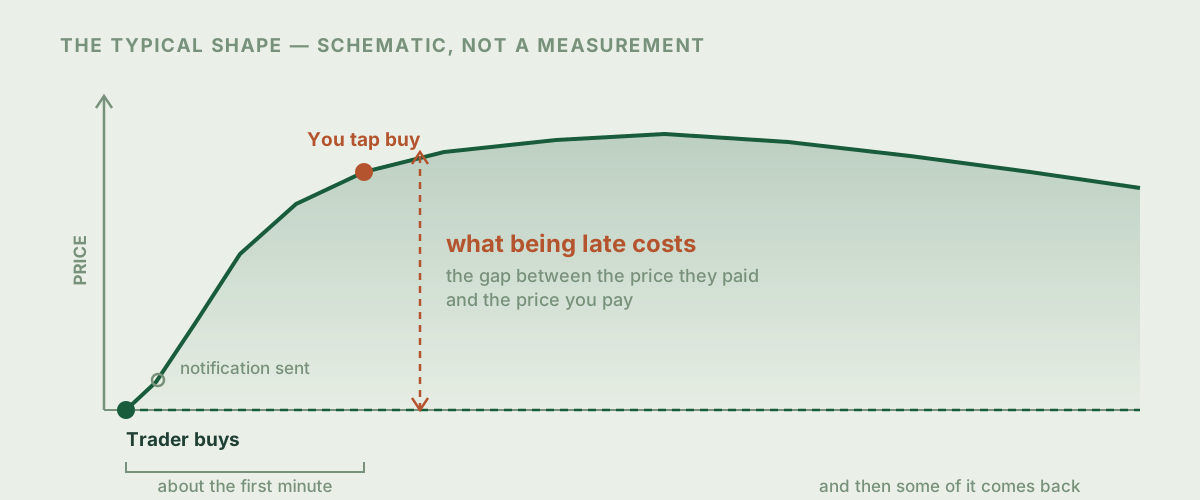
The price path after a well-followed first buy tends to have a characteristic shape. It moves quickly — most of the move lands inside the first minute or so — then flattens, and then some of it comes back. Not every token does this, and the size varies enormously. But the shape is consistent enough to plan around, and it explains why manual copying feels the way it does.
You are not slow because you are careless. You are slow because reading a notification, unlocking a phone, opening an app and tapping buy takes longer than the window in which the price was still close to the one the trader paid. The window is roughly a minute wide. A person cannot reliably act inside it, and a person who is asleep cannot act at all.
Explore this topic
What copy trading actually means
Three quite different things share the name, and the difference between them is most of the outcome.
- Notification and tap. An alert arrives, you open the app, you press buy. Your speed is human speed, which the shape above has already priced.
- Mirroring. Software watches the trader’s wallet and places your order without you. Now you are inside the first minute. Sizing is usually a flat amount or a flat percentage, and that is where most of the remaining damage happens.
- Strategy-level copying. The trader’s buy is one input to a program that also holds your position sizing, your cost limits, your token rules and your exits. The trader supplies a thesis. The program supplies the discipline.
Size it as a proportion, not as a ticket
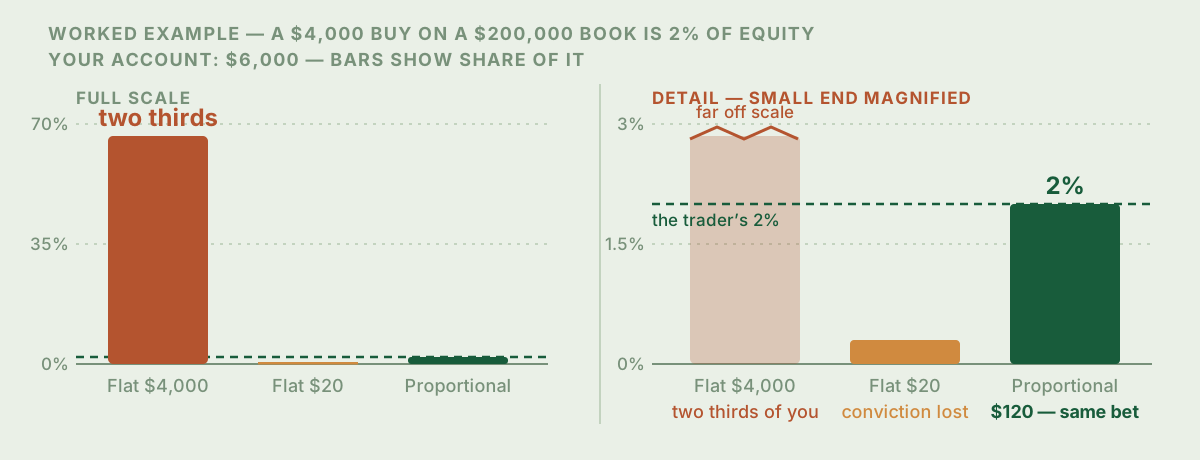
Take round numbers. A trader buys $4,000 of a token on a $200,000 book. That is a 2% position — a normal expression of moderate conviction. Copy it as a flat $4,000 into a $6,000 account and it is about two thirds of everything you own. Copy it as a flat $20 and it is a fraction of a percent, and whatever the trader was actually saying has been thrown away.
Flat tickets misrepresent conviction in both directions, and they do it silently. The only sizing rule that reproduces the bet the trader actually made is a proportional one: the same share of your account that it was of theirs.
Explore this topic
Exits decide the result, and exits are where products give up
An entry is a single public event, and it is easy to copy. An exit is not. The trader may sell in pieces, and the fraction that counts as “the same” exit is genuinely ambiguous for someone whose cost basis and position size are different. The trader may never sell at all. The trader may sell into liquidity that is gone by the time your order exists.
A tool that mirrors entries well and exits badly has sold you the risk and kept none of the resolution. When you are comparing products, this is the question to ask first, and it is the one most of them answer vaguely.
What we do differently
Four things, stated plainly.
- We aim to be the cheapest way to do this. Our goal is to be the most cost-efficient option for copy trading on FOMO, and to publish what we charge rather than reveal it after you have funded an account.
- We act in the first slot. We start work the moment the trader’s transaction appears on chain, not after it has comfortably settled.
- We skip instead of chasing. Every copy must pass your limits on price impact, slippage, signal age and the rest. One that cannot is declined, not resized.
- You see the skips. Declined copies appear in your activity feed with the reason. A tool that only shows you its fills is showing you a filtered sample of itself.
Explore this topic
How to start
Start smaller than feels interesting. The first week is not for making money; it is for finding out whether your limits are letting through the trades you meant them to.
- Find the wallets behind a handle. Enter a FOMO handle and we resolve the trader’s Solana and Robinhood Chain addresses, or enter the addresses yourself.
- Choose proportional sizing. Fixed amount and percentage-of-allocation are both available. Proportional is the one that copies the bet rather than the number.
- Set the limits you actually want. Maximum per trade, maximum exposure per asset, market-cap band, minimum liquidity, maximum slippage, maximum price impact, maximum signal age, order expiry.
- Fund a small allocation and activate. Each chain keeps its own account and its own cash, and one can never spend the other’s balance.
- Read the activity feed, including the skips. The skipped copies tell you more about whether your limits are set correctly than the filled ones do.
Explore this topic
Risk
Copying another trader does not reduce risk; it changes who is choosing it. Trading memecoins carries a high risk of losing the entire position. A leaderboard rank is a record of the past, not a claim about the future, and none of the traders visible on FOMO’s leaderboard is affiliated with quantfun.trade. Nothing here is financial advice.
Every figure in this article is round, approximate and chosen to make a mechanism visible. None of it is a measurement of any particular token or trader.

