A strategy you can build. A market you understand.
Choose your market and your starting point. Build a real example, one decision at a time, then explore its recorded backtest.
Read post Quant Fun
QUANT FUN / Blog
New features, platform introductions, and a closer look at what we’re building at Quant Fun.
Choose your market and your starting point. Build a real example, one decision at a time, then explore its recorded backtest.
Read post
Running a losing strategy backwards should print money, and almost never does. Why trading costs have no side, what the flip test really measures, and the checks that tell you whether your backtest is simulating a market or negating a number.
Read post
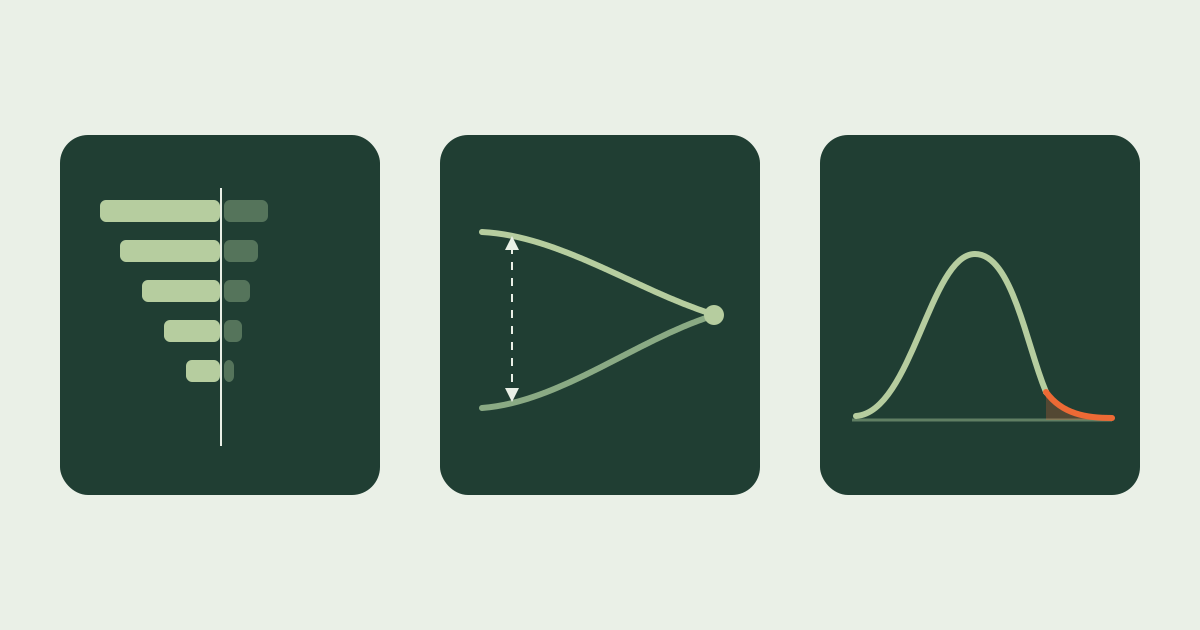
Breadth across assets is the easiest way to overstate evidence. Why a market mode, sectors, and styles collapse a large universe into a handful of independent directions—and what that does to your t-statistic.
Read post
Calendar time is a poor measure of evidence. Effective sample size, overlapping signals, regime coverage, and the number of variants you tried decide whether a backtest tells you anything at all.
Read post
What FOMO is, why manual copying is always late, how to size a copied trade so it means what the trader meant, and how to set up a first subscription.
Read post
Four reasons copying a FOMO trader is harder than it looks, where a trader’s gain goes on its way to you, and the execution architecture it takes to close the gap honestly.
Read postFeatured post ·
Order-book imbalance, the 2020 perpetual basis, and the first months of crypto UP/DOWN markets: three eras when a strategy you could explain in a paragraph was enough, and what closed each window.
Read post
Memory for a trading strategy: up to ten complete lifecycles, and the rules that move each market between them.
Read post
Learn how queue position affects limit-order fills, adverse selection, and the decision to wait, reprice, or cancel—with lessons from market microstructure research.
Read post
Understand hidden order size, native and synthetic icebergs, replenishment clues, and how to test execution decisions without mistaking suspicion for certainty.
Read post
Learn why perpetual futures need funding, how it resembles floating interest, and how hedged funding strategies earn—and lose—money after costs.
Read post
Compare Polymarket and Binance turnover through payoff, volatility, and time horizon. Learn where the embedded-leverage analogy helps and where it breaks.
Read post
Understand cross-exchange perpetual arbitrage through funding, basis risk, separate margin, contract differences, and a worked spread-profit example.
Read post
Add maker-order management, momentum confirmation, weather probabilities, and perpetual-market logic without turning the graph into a mystery.
Read post
Replay the first strategy, understand fills and drawdown, diagnose empty results, and compare changes without fooling yourself.
Read post
Turn one clear idea into a working graph. Learn the main blocks, choose a market, and build a BTC prediction-market strategy step by step.
Read post
Introducing a separate home for pooled yield, proprietary HFT and discretionary managed accounts that allocate to vaults on Quant Fun.
Read post
Preview an AI trading agent workflow in Quant Fun: connect market data, prompts, timed decisions, and order execution, with backtesting limits and AI costs.
Read post
Explore a random walk model for trading UP/DOWN contracts: turn volatility, Gaussian price steps, and settlement TWAPs into probability estimates.
Read post
What Knight Capital’s trading failure teaches about algorithmic trading infrastructure, deployment checks, and the value of tested strategy components.
Read post
Learn how adverse selection in trading hurts market makers and takers, why fills can go against you, and what to test beyond fill rate.
Read post
Automate trading universe selection in Quant Fun: filter assets by volume and market cap, use a custom list, and refresh your strategy’s markets on a schedule.
Read post
Meet Quant Fun, a platform for building AI-assisted trading strategies with tested components. Connect market data, inspect logic, and refine execution.
Read postExplore the platform and learn how strategies come together.